01 / Portability
The skill is not the vendor
Keep instructions in SKILL.md frontmatter and body. The same know-how travels between a local model, a hosted API and an agent harness without rewriting.
RAGBAZ / grove / Sylvae
The right worker for the job, with a receipt.
En portabel färdighetskörare: bär en SKILL.md-instruktion till en lokal modell, ett externt API eller en agent, välj körmiljö medvetet och behåll ett beständigt körningskvitto.
Active development · v0.1.0 prototype runner with local review surface

The grove: shared knowledge, different workers, visible roots.
01 / Portability
Keep instructions in SKILL.md frontmatter and body. The same know-how travels between a local model, a hosted API and an agent harness without rewriting.
02 / Honesty
Every run has an identity, a backend, a model, timing and an outcome. Unavailable budget, refused invocation and unsuccessful results are three different records.
03 / Economy
Cheap, frontier and agent are different resources with different fixed costs. Declared routing keeps a trivial prompt off a six-second agent bootstrap.
The receipt problem / Brief 01
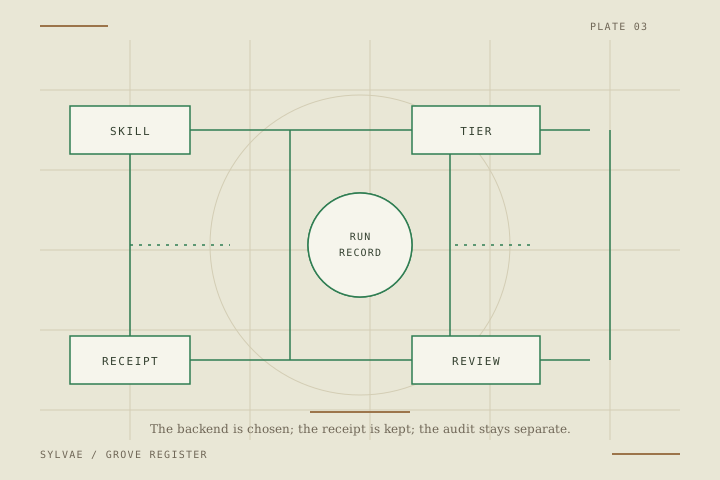
A practical path from an explicit backend choice to a run record and commit-bound evidence.
Read the runs brief01 Sylvae
Sylvae kör en SKILL.md-instruktion mot Ollama, Claude Code, Codex, OpenCode eller Anthropics API. Fyra av fem bakgrunder återanvänder CLI-verktyg du redan är inloggad på.
Välj nivå uttryckligen: billig, frontier eller agent. Automatik gissar aldrig att något är billigt. Explicita val spelar roll eftersom verkliga körningar kostar verklig tid, tokens och pengar.
02 Sylvae
Installera från källkod, kör en liten färdighet mot en lokal modell och läs kvittot. En saknad bakgrund, en förbrukad budget eller ett nekat anrop är inte samma sak som ett misslyckat resultat.
De engelska fördjupningarna visar bakgrunder, granskningssidan och ombudsvägen för agenter. De blandar inte ihop lokal verifiering med ett beslut om driftsättning.
A cooperative workshop
Use one tool where it helps, or connect the whole workshop. People keep the purpose and judgment; the tools make the work easier to explain.
From intention to understanding
Describe the job and expected output in SKILL.md with a declared tier. Start small enough that another person can assess the result.
Name a local model for a first experiment, or map tiers to your actual host and accounts. Read what auto would choose before letting it choose.
Inspect input, output, model, timing and status. Unavailable, failed and successful runs answer different questions.
Correlate the run ID with WeftMark evidence, check audit integrity with Nostoi where useful, and keep the human judgment explicit.
Bring the threads to the loom →A small first step
Use a source checkout, Python environment and an already configured Ollama installation. Download the model you intend to use and prepare a small input file.
Model downloads need storage and bandwidth. Hosted and agent backends have their own credentials and costs; do not assume automatic routing is free.
git clone https://github.com/tabenius/sylvae.git
cd sylvae
python3 -m venv .venv
. .venv/bin/activate
pip install .ollama pull mistral:latest
sylvae run skills/summarize-diff --backend ollama \
--model mistral:latest --input /path/to/a/diff.txtsylvae runs
sylvae reviewThe routing desk / Illustrated cases
Select a case to see how a declared tier, an explicit backend and a recorded outcome relate. Backend and model names are the documented ones, not live measurements.
Presentation-only illustrations. No model runs, no spending occurs, and no review is authorised by this explorer.
The skill names its tier; the router honours it without interpretation.
Illustration: explicit cheap work never leaves the machine. Operating the model remains your own cost to weigh.
No tier key means the safe choice, on a separate account.
Illustration: the default protects an interactive budget from silent consumption; it does not promise the cheapest adequate answer.
A harness with tools is a different resource from a bigger model.
Illustration: route multi-step work here deliberately; keep trivial prompts away from it.
The run never happened, so there is nothing to debug in the skill.
Illustration: record the absence and act on it. Do not rewrite the skill to fix a run that never ran.
A conversation, not a sales funnel
Ask a question, tell us what you need, offer a contribution or simply show your support. RAGBAZ is a software studio working toward kindness, mutual cooperation and the good of all beings.
Prefer email? ragbaz@proton.me